Software development in 2026 looks nothing like it did even two years ago. Engineering teams are shipping faster than ever, yet a paradox persists at the heart of every development organization: developers spend less than a third of their working hours actually writing code. The rest disappears into a black hole of context switching, pull request reviews, issue triage, CI/CD pipeline babysitting, and the endless administrative overhead that modern software delivery demands. A recent Stack Overflow survey found that developers lose an average of 8.2 hours per week to non-coding tasks, and GitHub's own research suggests that the average pull request sits unreviewed for over 24 hours before a human even looks at it.
This is not a tooling problem in the traditional sense. GitHub itself is an extraordinary platform, arguably the most important piece of infrastructure in modern software engineering. The problem is that GitHub was designed for humans to operate manually, and humans are increasingly the bottleneck. Every repository generates a constant stream of events — new issues filed, pull requests opened, CI checks failing, dependencies flagged as vulnerable — and each event demands human attention, human judgment, and human action. When your team is small, this is manageable. When you are operating at scale with dozens of repositories, hundreds of contributors, and thousands of issues, the cognitive load becomes crushing.
This is precisely where AI agents enter the picture, not as a replacement for developers but as an autonomous layer that handles the repetitive, time-consuming work that keeps engineers from doing what they do best. SuperNinja's GitHub connector, built on the Model Context Protocol (MCP), creates a direct bridge between NinjaTech AI's autonomous agent platform and your GitHub repositories. The result is an AI teammate that can review code, manage issues, automate workflows, and keep your development pipeline moving — all through natural language commands and intelligent automation.
What Is the Model Context Protocol and Why Does It Matter for GitHub?
Before diving into specific use cases, it is worth understanding the technology that makes SuperNinja's GitHub integration fundamentally different from traditional automation tools like Zapier or GitHub Actions. The Model Context Protocol, commonly known as MCP, is an open standard originally developed by Anthropic that has rapidly become the industry standard for connecting AI agents to external tools and services. Think of MCP as a universal translator between AI models and the applications they need to interact with. Rather than building brittle, custom API integrations for every tool, MCP provides a standardized interface that allows any AI agent to discover, authenticate with, and execute actions across hundreds of applications.
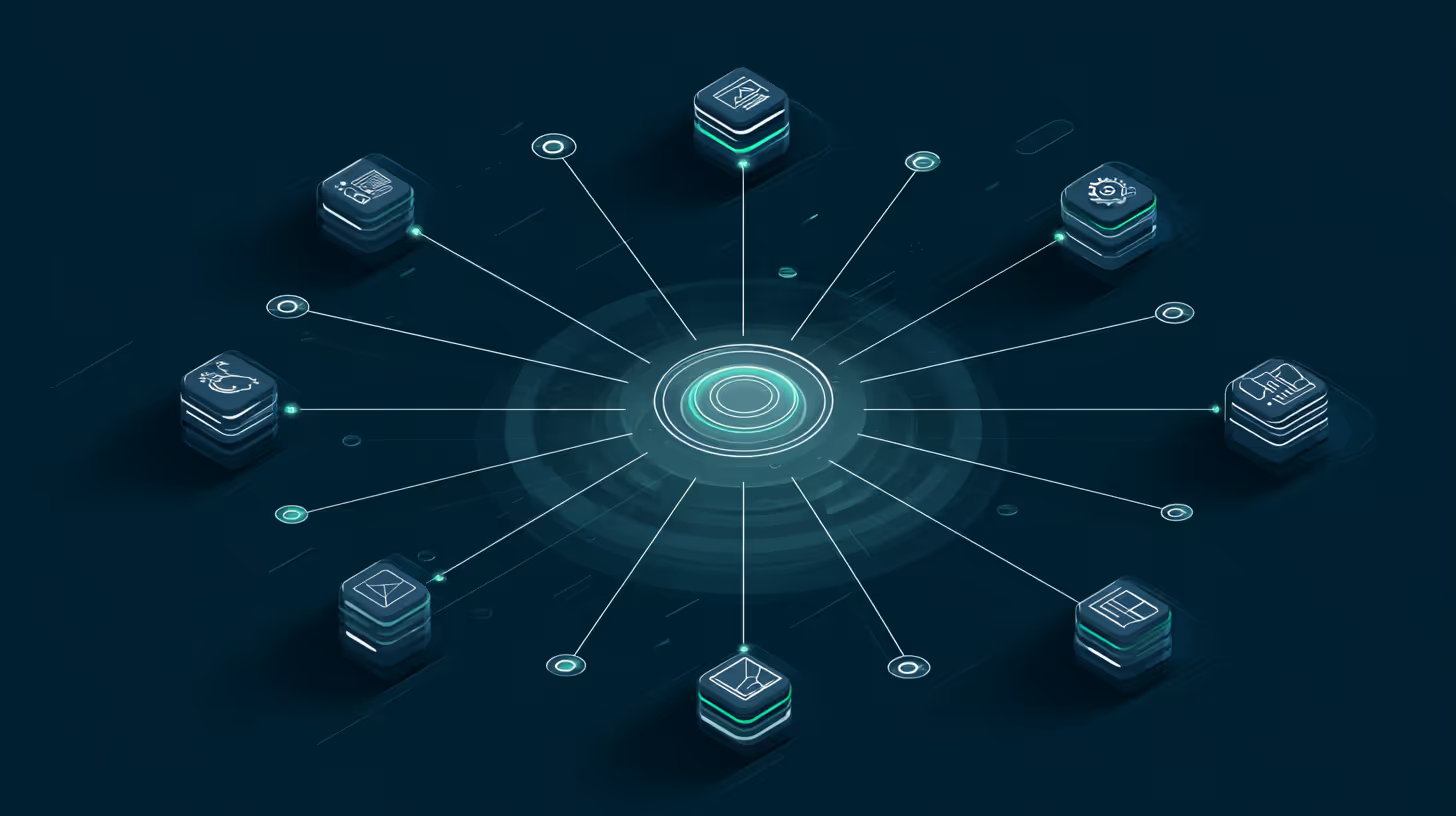
SuperNinja leverages MCP to connect directly to GitHub's API surface, giving the AI agent full contextual awareness of your repositories, branches, issues, pull requests, workflows, and more. This is not a simple webhook or notification system. The MCP connector enables SuperNinja to read repository contents, understand code context, create and modify issues, review and comment on pull requests, trigger workflows, and manage releases — all within the secure, isolated virtual machine environment that every SuperNinja task runs inside. Because each task executes in its own dedicated VM, your GitHub credentials and repository data never leak between sessions or users, a critical security consideration that many competing solutions overlook.
Why Connect GitHub to an AI Agent?
The question is not whether AI will transform software development workflows — that transformation is already underway. The question is whether you will harness it proactively or find yourself falling behind teams that do. Connecting GitHub to an autonomous AI agent like SuperNinja unlocks capabilities that go far beyond what traditional automation can achieve, because an AI agent does not simply execute predefined scripts. It reasons about context, makes judgment calls, and adapts its behavior based on the specific situation it encounters.
Traditional automation tools operate on rigid if-then logic: if a file changes, run this script. AI agents operate on goal-based reasoning: given this pull request, what should a knowledgeable reviewer look for?
Consider the difference between a GitHub Action that runs a linter on every pull request and an AI agent that reviews the actual logic of the code changes, identifies potential bugs, suggests improvements based on your team's coding standards, and writes a thoughtful review comment that explains its reasoning. The former is automation. The latter is intelligence. Traditional automation tools operate on rigid if-then logic: if a file changes, run this script. AI agents operate on goal-based reasoning: given this pull request, what should a knowledgeable reviewer look for, and what feedback would be most helpful to the author?
The practical benefits compound quickly. Engineering managers gain visibility into repository health without manually checking dashboards. Junior developers receive instant, constructive feedback on their code without waiting hours for a senior engineer to become available. DevOps teams can delegate routine pipeline maintenance to an agent that monitors, diagnoses, and often resolves issues autonomously. And across the entire organization, the institutional knowledge that typically lives only in senior engineers' heads becomes accessible through an AI agent that has been trained on your codebase, your conventions, and your architectural decisions.
Top Use Cases: SuperNinja + GitHub in Action
1. Intelligent Code Review and Pull Request Analysis
Code review is simultaneously one of the most valuable and most time-consuming activities in software engineering. A thorough review catches bugs before they reach production, enforces coding standards, and serves as a knowledge-sharing mechanism across the team. Yet the reality in most organizations is that reviews are rushed, inconsistent, or delayed because reviewers are juggling their own development work. SuperNinja transforms this dynamic by acting as a first-pass reviewer on every pull request. When a PR is opened, you can ask SuperNinja to analyze the changes, and the agent will examine the diff in context, identify potential issues such as missing error handling, inefficient algorithms, security vulnerabilities, or deviations from established patterns, and post a detailed review comment directly on the pull request. This does not replace human review — it augments it by ensuring that the human reviewer can focus on architectural decisions and business logic rather than catching syntax issues and style violations.

2. Automated Issue Triage and Labeling
Open-source maintainers and engineering teams alike struggle with the sheer volume of issues that accumulate in active repositories. New issues arrive without proper labels, duplicate issues pile up, and critical bugs get buried under feature requests. SuperNinja can monitor your repository's issue tracker and automatically triage incoming issues by reading the issue description, analyzing its content against existing issues to detect duplicates, applying appropriate labels based on the issue's nature (bug, feature request, documentation, performance, security), assigning priority levels, and even routing the issue to the most appropriate team member based on the affected code area. This transforms issue management from a manual, error-prone process into an intelligent, consistent system that ensures nothing falls through the cracks.
3. Repository Health Monitoring and Reporting
Engineering managers and tech leads need a clear picture of repository health, but assembling that picture typically requires checking multiple dashboards, running queries, and synthesizing information from various sources. With SuperNinja's GitHub connector, you can simply ask the agent to generate a comprehensive repository health report. The agent will analyze open issues and their age distribution, pull request velocity and review turnaround times, stale branches that need cleanup, dependency status and known vulnerabilities, CI/CD pipeline success rates, and contributor activity patterns. The resulting report is delivered as a structured document that you can share with stakeholders, use in sprint retrospectives, or track over time to measure improvement.

4. Release Notes and Changelog Generation
Writing release notes is one of those tasks that everyone agrees is important but nobody wants to do. It requires reviewing every merged pull request since the last release, understanding the user-facing impact of each change, and writing clear, concise descriptions that make sense to both technical and non-technical audiences. SuperNinja automates this entirely. Point the agent at a release branch or a range of commits, and it will analyze every merged PR, categorize changes into features, bug fixes, improvements, and breaking changes, generate well-formatted release notes with appropriate detail levels, and even draft announcement posts for your team's Slack channel or blog. The agent understands the semantic meaning of code changes, so it can distinguish between a minor refactor and a significant feature addition, producing release notes that are genuinely useful rather than just a list of commit messages.
5. CI/CD Pipeline Debugging and Optimization
When a CI/CD pipeline fails, the typical developer experience involves clicking through to the build logs, scrolling through hundreds of lines of output, identifying the relevant error, and then figuring out whether the failure is a genuine code issue, a flaky test, an infrastructure problem, or a dependency conflict. SuperNinja can analyze pipeline failures in real time, reading the build logs, identifying the root cause, and either suggesting a fix or, in many cases, implementing the fix directly by opening a pull request with the necessary changes. For recurring issues like flaky tests, the agent can track failure patterns over time and recommend which tests need to be rewritten or quarantined. This turns CI/CD maintenance from a reactive, interrupt-driven activity into a proactive, managed process.

6. Documentation Generation and Maintenance
Documentation debt is a universal problem in software engineering. Code evolves faster than documentation, and the gap between what the code does and what the docs say it does grows wider with every sprint. SuperNinja can bridge this gap by analyzing your codebase and generating or updating documentation automatically. Ask the agent to document a specific module, and it will read the source code, understand the function signatures, class hierarchies, and data flows, and produce clear, well-structured documentation complete with usage examples. For existing documentation, the agent can compare the docs against the current codebase and flag sections that are outdated, missing, or inaccurate.
7. Security Vulnerability Assessment
Security is everyone's responsibility, but not every developer has the expertise to identify subtle vulnerabilities in code. SuperNinja can perform security-focused code reviews that specifically look for common vulnerability patterns such as SQL injection, cross-site scripting, insecure deserialization, hardcoded credentials, and improper input validation. When the agent identifies a potential vulnerability, it does not just flag it — it explains the risk, provides a concrete example of how the vulnerability could be exploited, and suggests a specific remediation approach. This democratizes security expertise across the team and catches issues that might slip past a general code review.
Getting Started: Connecting SuperNinja to GitHub
One of the most compelling aspects of SuperNinja's connector architecture is its simplicity. Unlike traditional integration platforms that require extensive configuration, API key management, and workflow design, SuperNinja's MCP-based connectors are designed to work through natural language. Getting started with the GitHub connector involves just a few straightforward steps.
First, log in to your SuperNinja account at super.myninja.ai. Navigate to the connectors section and select GitHub from the available integrations. You will be prompted to authenticate with your GitHub account using OAuth, which grants SuperNinja secure, scoped access to your repositories. You control exactly which repositories the agent can access, and you can revoke access at any time. Once connected, you can immediately start interacting with your GitHub data through natural language. There is no workflow builder to configure, no automation rules to define, and no scripting required. Simply tell SuperNinja what you need — "Review the open pull requests in my frontend repo and summarize the changes" or "Create an issue in the backend repo for the login bug we discussed" — and the agent handles the rest.
The beauty of this approach is that it scales with your needs. You might start by using SuperNinja for simple tasks like generating release notes or triaging issues, and gradually expand to more complex workflows as you discover new ways the agent can help. Because SuperNinja is an autonomous agent rather than a rigid automation tool, it adapts to your workflow rather than forcing you to adapt to it.
SuperNinja vs. Traditional GitHub Automation: A New Paradigm
To appreciate the paradigm shift that AI agents represent, it helps to compare SuperNinja's approach with the traditional tools developers use to automate GitHub workflows. GitHub Actions, for example, is a powerful CI/CD and automation platform, but it operates on a fundamentally different model. Actions are event-driven scripts: when X happens, do Y. They cannot reason about context, make judgment calls, or handle ambiguous situations. If a GitHub Action encounters an unexpected scenario, it fails. If SuperNinja encounters an unexpected scenario, it reasons about the situation and adapts.
Similarly, tools like Zapier and n8n can connect GitHub to other applications, but they are limited to predefined triggers and actions. They can create an issue when a form is submitted or send a Slack notification when a PR is merged, but they cannot understand the content of a pull request, evaluate code quality, or generate meaningful documentation. These tools automate tasks. SuperNinja automates judgment.
GitHub Copilot helps you write code faster. SuperNinja helps you manage the entire development lifecycle more intelligently. The two are complementary rather than competitive.
The comparison extends to developer-focused AI tools as well. GitHub Copilot is excellent at code completion within the editor, but it does not interact with GitHub's project management features, cannot review pull requests, and does not manage issues or releases. Copilot helps you write code faster. SuperNinja helps you manage the entire development lifecycle more intelligently. The two are complementary rather than competitive — you might use Copilot to write code and SuperNinja to review, document, and ship it.
Best Practices for AI-Powered GitHub Workflows
As with any powerful tool, getting the most out of SuperNinja's GitHub connector requires thoughtful implementation. Start with high-volume, low-risk tasks like issue triage and release note generation before moving to more sensitive workflows like code review. This allows your team to build confidence in the agent's capabilities and calibrate its behavior to your specific standards and conventions.
Be specific in your instructions. While SuperNinja can handle broad requests like "review this PR," you will get better results by providing context: "Review this PR focusing on error handling and performance implications, and flag any changes that might affect our API response times." The more context you provide, the more targeted and useful the agent's output will be.
Establish a feedback loop. When SuperNinja's review catches a genuine issue, acknowledge it. When it flags something that is not actually a problem, let the team know so you can refine your approach. Over time, this iterative process produces increasingly valuable results as you learn how to communicate most effectively with the agent.
Finally, remember that AI agents are force multipliers, not replacements. The goal is not to eliminate human code review but to make human reviewers more effective by handling the routine checks and freeing them to focus on the architectural and design decisions that require human expertise and creativity.
Conclusion: The Future of Development Is Agentic
The integration of AI agents into developer workflows is not a future possibility — it is a present reality that is reshaping how software teams operate. SuperNinja's GitHub connector represents a new category of developer tooling, one that goes beyond simple automation to deliver genuine intelligence in the development pipeline. By connecting your GitHub repositories to an autonomous AI agent that can reason about code, manage projects, and automate workflows through natural language, you unlock a level of productivity and consistency that was previously impossible.

The teams that embrace this shift early will ship faster, maintain higher code quality, and free their engineers to focus on the creative, high-impact work that drives business value. The teams that wait will find themselves increasingly outpaced by competitors who have learned to leverage AI not just for writing code, but for managing the entire software development lifecycle.
SuperNinja's GitHub connector is available today for all plan levels. Connect your repositories, start with a simple task, and experience firsthand how an AI agent can transform your development workflow. Visit super.myninja.ai to get started for free.