Satya Nadella wrote something important this week. In an essay he called "The Reverse Information Paradox", he made a point that stuck with me: in the AI age, you pay for intelligence twice. Once with money, and again with the institutional knowledge you hand over to make that intelligence useful. Every prompt, every correction, every eval your people write is proprietary know-how, and in most of today's arrangements it quietly flows out of your company and into someone else's model.
He's right. At NinjaTech AI we've spent two years building the company that assumes he's right and does something about it. So I'll say it plainly, the way I'd say it to a CIO or CFO across the table: stop renting your company's intelligence. Own it. I don't mean buy GPUs. I mean own the learning, the judgment, the accumulated know-how that makes your AI good at your business. That is an asset. We built NinjaTech AI so you can.
A week earlier, Palantir's Alex Karp put it bluntly on CNBC: technical customers want to own the means of production, not transfer it to someone else. Two vantage points, one conclusion. The learning is the asset, and it should stay with you.
The five principles, made operational
Satya lays out five things every enterprise should demand. Here's how we deliver each.
1. Control. Nothing leaves your perimeter without consent: not a prompt, not a trace, not your institutional knowledge. Deploy in your own cloud, VPC, or air-gapped, with a contractual guarantee your data never trains a vendor's model.
2. Capability. Don't buy a chatbot that suggests answers. Buy AI employees that finish the work. Ours run long, from hours to weeks, plugging into 3,000+ enterprise systems with full browser control, self-correcting until the job is done.
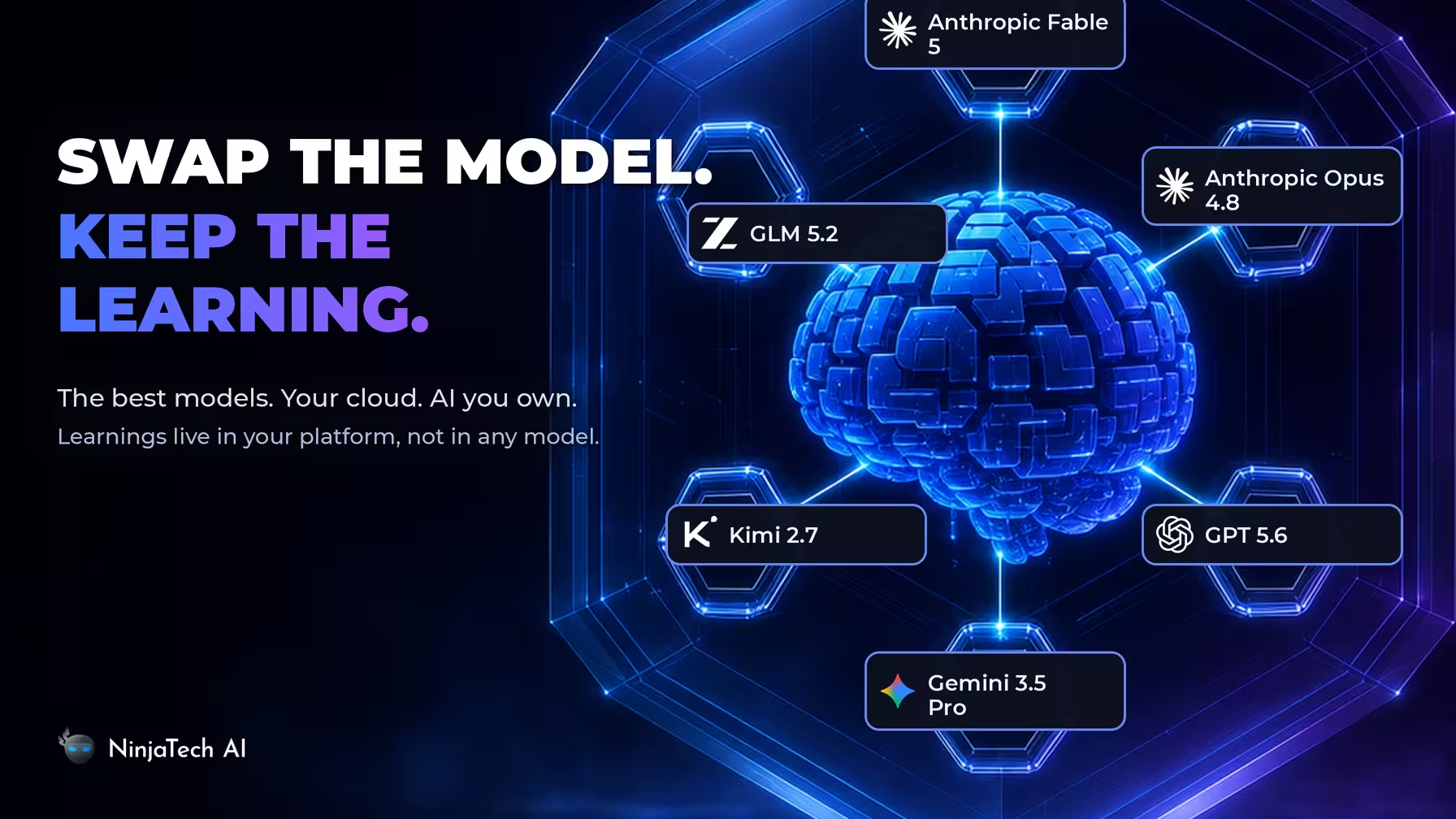
3. Choice. Never be a hostage to one model. Run frontier and open-weight models side by side and switch any time. This works because your learning is decoupled from the model and owned by you, so swapping the model never costs you your accumulated expertise. Model lock-in is just vendor lock-in in a lab coat.
4. Cost. Move off per-seat and per-token pricing for your core work. Per-token billing is a tax on your own success: the harder your best people lean on it, the bigger the invoice. Cap cost by hardware you control and run it unmetered, often 5 to 10 times cheaper on GPUs, with zero lock-in.
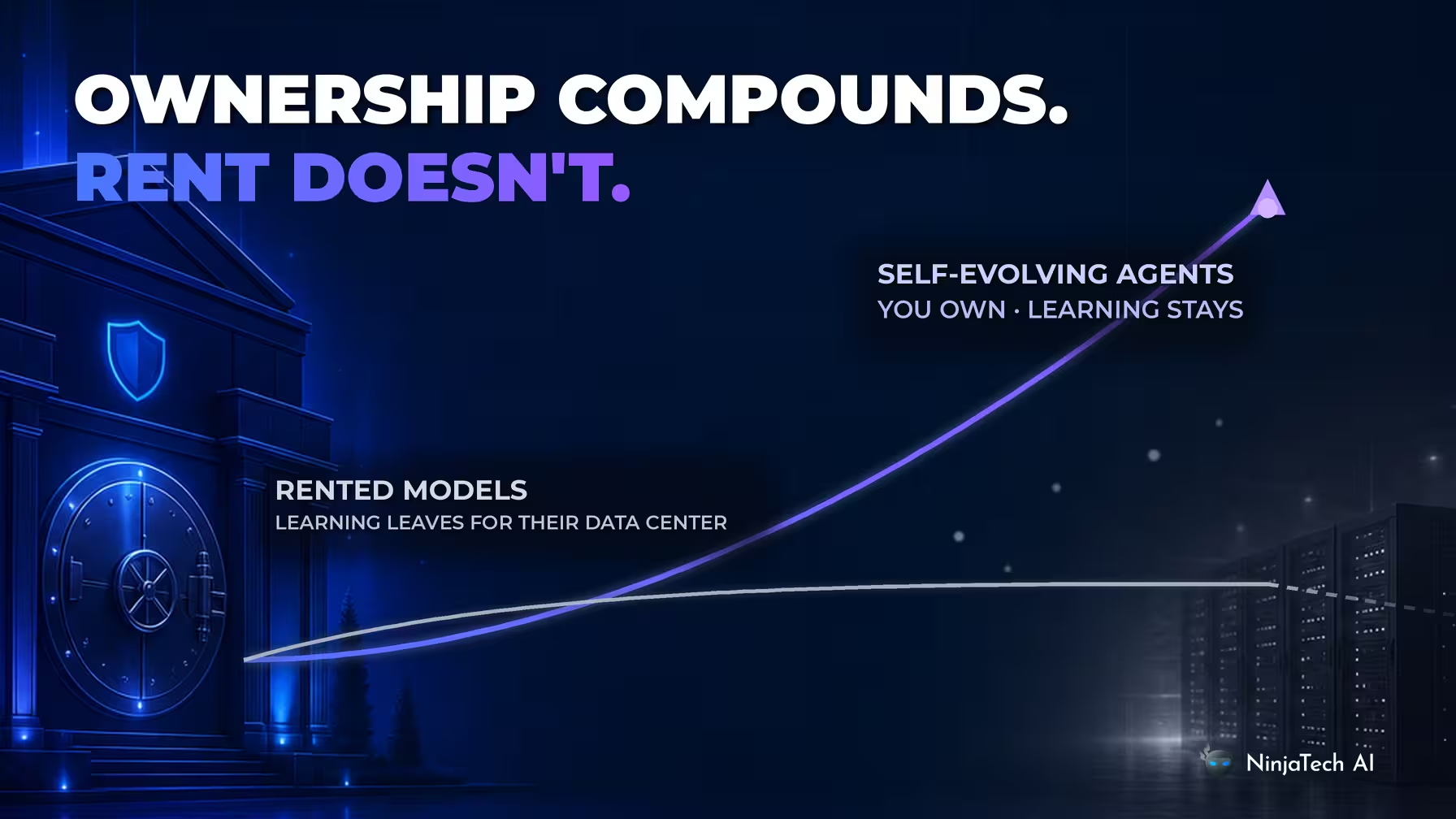
5. Compound. This is the whole game. Our agents are self-evolving: every completed task teaches the next, specialized to your domain, and every gain stays inside your walls. A competitor renting a shared model stands still while paying by the hour, while your workforce sharpens on your business every day. That gap is your advantage. Renting gives you access. Owning gives you an asset that appreciates.
Two more we learned the hard way
Satya's five are the foundation. Building this for real enterprises taught us two more that decide whether the other five ever pay off. You can own the most capable, self-improving intelligence in your industry and still get nothing from it if your people won't use it and your team can't get it deployed.
6. Zero UI. AI is already complex; making people learn a new console adds friction where you can least afford it, and it's why so many rollouts stall after the pilot. So our next-generation platform has no app to adopt. You work with your AI employees where your teams already talk: Slack, Microsoft Teams, and WhatsApp. Deploy one like a contractor, give each project its own channel, and it collaborates with everyone in it, keeps context, takes the work, and keeps going while your people sleep. Adoption becomes as easy as adding someone to a channel.
7. Partnership. Powerful AI with no one to guide the rollout is how budgets get wasted. Enterprises need people who onboard them and stay through the whole journey. That's why we've partnered with Infosys for enterprise deployment at global scale, with Simplus, an Infosys company, for automation, and with Optimum Healthcare IT, also an Infosys company, for healthcare. No one gets thrown in the deep end. More on these partnerships very soon.
What I'm recommending to CIOs and CFOs
The defining corporate asset of the AI era is your learning, and whether you own it. Here's how I'd act on it.
- Draw a hard trust boundary, in your own cloud, with a guarantee your data never trains a vendor's model.
- Separate the learning from the model. Own the layer where expertise accumulates; make the model a swappable component, not the vault your knowledge lives in.
- Refuse single-model lock-in, and lose no learning when you switch.
- Convert the meter into a fixed asset. Cap cost by hardware you control and run it unmetered.
- Buy the compounding loop, not the chatbot. Insist on agents that self-improve inside your walls.
- Meet people where they work, so adoption is as easy as adding a colleague to a channel.
- Insist on a delivery partner, not just a login.
- Prove it on one hard workflow first, behind your firewall, then scale from evidence.
Own it
In the cloud era, the winners owned their data. In the AI era, they'll own their intelligence: one that stays inside their walls, keeps its memory when models change, costs a fixed line instead of a runaway meter, and grows sharper every day. The industry is finally describing the problem out loud. We shipped the answer.
So stop renting your intelligence by the token. Own it. If any of this resonates, tell us your hardest workflow and we'll show you an AI employee finish it inside your own cloud. Fill out the form at ninjatech.ai/request-a-demo, or email sales@ninjatech.ai. We'll bring the proof; you bring your strictest reviewer.